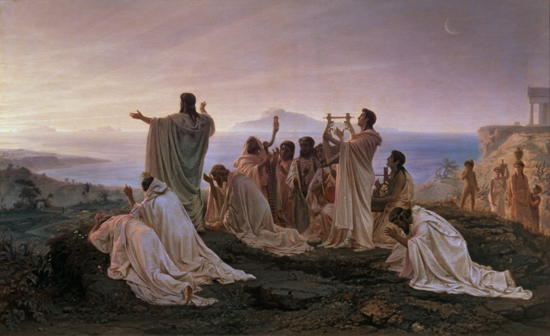
Pythagoras founded a philosophical and religious school in Croton (now Crotone, on the east of the heel
of southern Italy) that had many followers. Pythagoras was the head of the society with an inner circle
of followers known as mathematikoi. The mathematikoi lived permanently with the Society, had no personal
possessions and were vegetarians. They were taught by Pythagoras himself and obeyed strict rules.
The beliefs that Pythagoras held were:
(1) that at its deepest level, reality is mathematical in nature,
(2) that philosophy can be used for spiritual purification,
(3) that the soul can rise to union with the divine,
(4) that certain symbols have a mystical significance, and
(5) that all brothers of the order should observe strict loyalty and secrecy.
Both men and women were permitted to become members of the Society, in fact several later
women Pythagoreans became famous philosophers. The outer circle of the Society were known
as the akousmatics and they lived in their own houses, only coming to the Society during the day.
They were allowed their own possessions and were not required to be vegetarians.